

Engineering principles for controlled injection beneath industrial foundations.
Improving weak supporting ground through controlled injection
Factory settlement does not always begin in the visible structure. When soil beneath a foundation is weak, disturbed or unable to support loads uniformly, foundation movement can lead to cracks, tilting, gaps and distortion in the structure above.
US Patent No. 9,822,497, titled Treating particulate and connecting slab portions, describes methods for treating particulate materials—including soil, sand, gravel and similar materials—by injecting material at multiple locations, monitoring the effects and stopping or adjusting injection in response to observed movement. The specification also describes injection beneath structures supported by the ground, including applications involving slabs and loaded foundation pads.
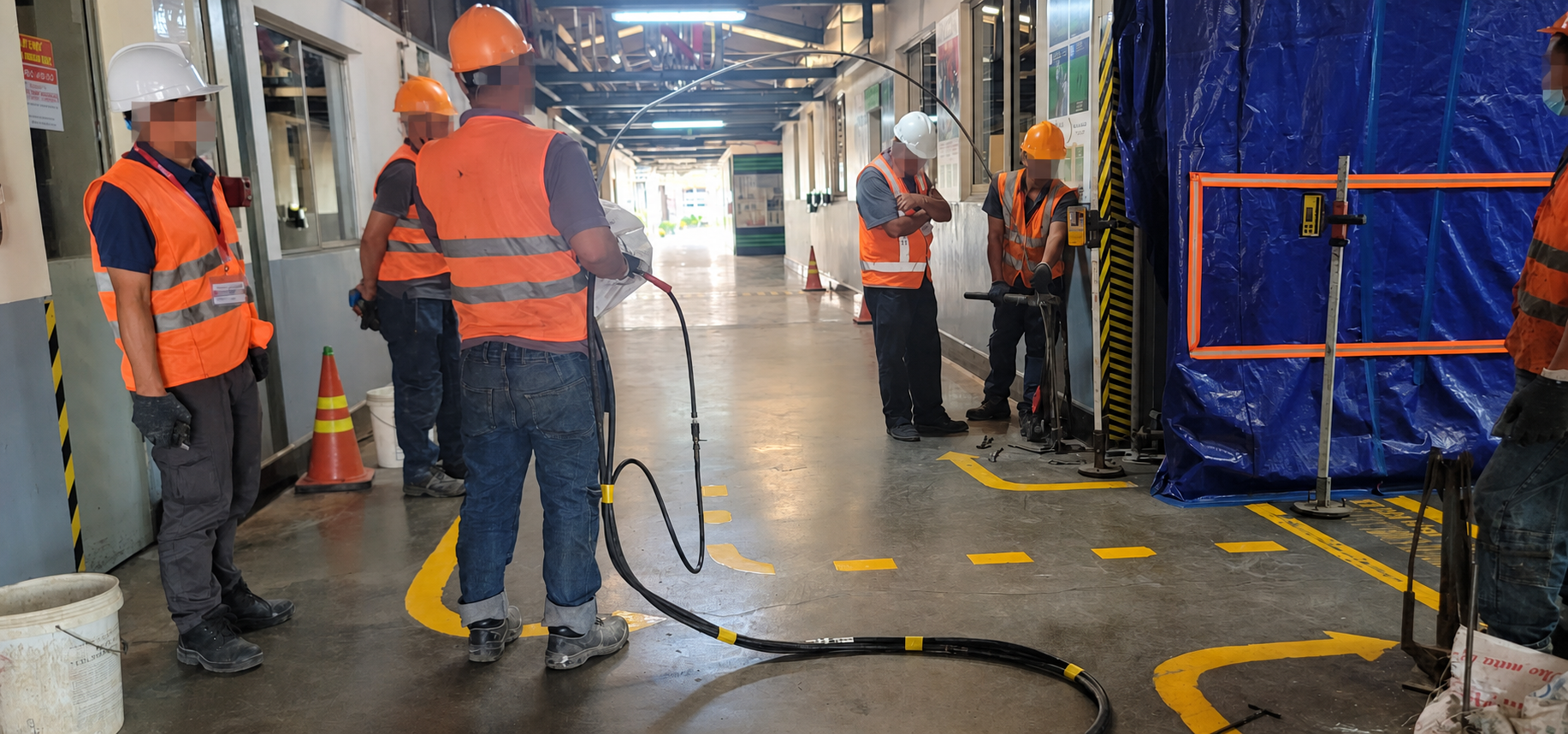
Anonymized URETEK site image: monitored Deep Injection work at an industrial facility. The image illustrates delivery practice; it does not establish suitability or outcomes for every project.
Engineering principles relevant to industrial foundation settlement
1. Treating the supporting soil—not merely filling a void
The patent specification distinguishes injection into the ground requiring treatment from simply placing material in a void or an upper layer. The engineering objective is to act on the load-supporting zone beneath the structure.
2. Sequential injection at multiple locations
Material may be injected sequentially at a series of points. Depths and injection patterns can vary according to site conditions. For a supported structure, points may be arranged around the load-transfer footprint and at other locations where treatment is required.
3. Monitoring during injection
A central principle is monitoring the effect of injection, including surface displacement, then reducing, pausing or stopping injection in response. This provides a basis for controlling how the ground and structure react during treatment.
4. Settable or expanding materials
The specification refers to hardenable materials, including multi-component expanding polymers, as well as other material options selected according to engineering and construction requirements.
Original explanatory diagram prepared by URETEK from relevant engineering principles described in US Patent 9,822,497. Not to scale; project design depends on investigation findings and site conditions.
How is Deep Injection applied?
URETEK Vietnam does not select a repair method solely from visible cracking or settlement. The process begins by identifying the settlement mechanism, foundation load path, weak layers, water conditions and affected area.
Where Deep Injection is suitable, injection tubes are advanced to the target depths. Material is introduced in controlled stages while the response of the structure is monitored. Injection position, depth, volume and sequence must be adapted to investigation data, field response and the engineering objectives of each project.
When should Deep Injection be considered?
- Settlement is associated with weak or disturbed soil beneath foundations.
- The facility needs a minimally invasive approach with limited production disruption.
- The treatment zone can be accessed and foundation response can be monitored.
- Investigation results show that ground improvement by injection is technically appropriate.
When may steel micropiles be more appropriate?
Deep Injection is not the default answer for every settlement problem. Steel micropiles may be more appropriate where weak strata extend too deep, loads need to be transferred directly to a deeper competent layer, significant foundation or structural damage is present, or the design requires a defined structural load path. Some projects may require a combined approach.
The decision should be based on geotechnical investigation, structural assessment, loads, access constraints and the operational objectives of the facility.
Does a patent guarantee the outcome of every project?
No. A patent defines protected subject matter; it does not replace investigation, design, quality control or project-specific suitability assessment. Performance depends on ground conditions, structure, loading, groundwater, access and execution under an appropriate engineering plan.
Frequently asked questions
How does US Patent No. 9,822,497 relate to factory settlement?
The patent describes principles for treating supporting particulate ground through sequential injection, monitoring and responsive control, including situations involving ground-supported structures, slabs and loaded foundation pads.
Does Deep Injection require foundation excavation?
The method is generally delivered through small injection holes and tubes, reducing the need for large-scale excavation. The precise access method remains project-specific.
Can the process both improve ground and correct movement?
Under suitable conditions, controlled injection can produce an uplift response. Any lifting objective must be assessed, monitored and controlled for the project; it is not an automatic outcome.
How do engineers choose between Deep Injection and steel micropiles?
The choice depends on the settlement mechanism, depth of weak soil, loads and required load path. Deep Injection treats supporting ground; micropiles transfer loads to a deeper competent layer.
Contact URETEK Vietnam for site assessment, diagnosis of the settlement mechanism, and selection of Deep Injection, steel micropiles or an appropriate combined approach.
Technical source: US Patent No. 9,822,497, “Treating particulate and connecting slab portions,” granted 21 November 2017. Search patent number 9822497 at USPTO Patent Public Search; view the direct readable record at Google Patents. This page provides general technical information and is not legal advice or a guarantee of suitability for every project.
Publication implementation notes
- Link the Vietnamese page to /chong-lun-nha-xuong/, the Vietnamese Deep Injection/soil-improvement page, the steel-micropile page and approved relevant case studies.
- Link the English page to the corresponding industrial-settlement, Soil Improvement and Steel Micropile pages.
- Use the included anonymized URETEK site photo and original explanatory diagram; retain the captions and descriptive alt text.
- Include both the official USPTO search link and the direct readable Google Patents record.
- Add Article, BreadcrumbList and FAQPage structured data only where the visible page content matches it exactly.
- Set the exact custom SEO titles and meta descriptions above; do not append a second site-name suffix.
- Render one H1 only, use H2 for the main article sections and H3 for visible FAQ questions; suppress duplicate theme-generated headings.
- Keep the main commercial keyword on the service page; this patent page targets patent/method/authority intent.
- Do not publish until Doan approves this exact copy together with the final images, layout, links and metadata.
Reference: US9822497B2 patent record. Patent record identifies Rigid Ground Pty Ltd as assignee and shows grant/publication on 21 November 2017.